
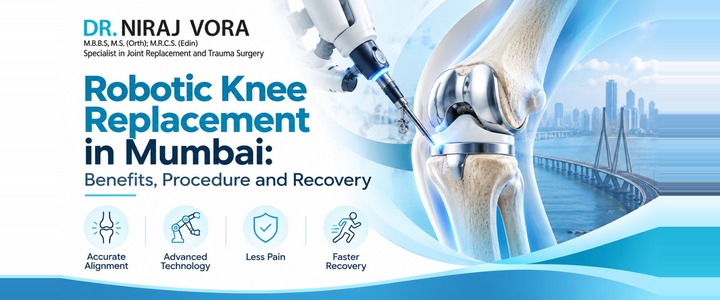
At a certain point in life, the knee starts deciding things for you. Climbing stairs needs planning, evening walks get cut, and your knee’s mood decides where you can go. Painkillers that used to help barely take the edge off. The mention of ‘knee replacement surgery’ brings a sigh of relief but also brings the image of a heavy operation and a lengthy procedure.
You have heard about an advanced robotic knee replacement procedure that is super-accurate, shortens recovery time, and delivers better outcomes. You want to read about the robotic knee replacement procedure but find the information scattered across the web, and you worry about whether you can trust the sources.
But worry not. When it comes to Dr.Niraj Vora, a pioneer of robotic surgery in Mumbai and one of the very few surgeons certified on four robotic platforms, including Mako and CORI. So read on:
Robotic Knee Replacement Procedure: How Is It Done?
In conventional knee replacement procedures, the surgeon removes the worn surfaces of the thigh and shin bones to fit a metal-and-plastic implant that mimics natural movement. The main challenge in a knee replacement procedure is accurately assessing and restoring your knee’s natural alignment and ligament balance so the implant sits in the right position.
A robotic knee replacement procedure is a robot-assisted procedure in which the surgeon, using advanced medical robotic technology, plans and places the implant with millimeter-level precision, tailored to the unique shape of your knee. And the surgeon accomplishes this in three stages with the help of robotic technology:
• Mapping: Advanced tiny medical trackers on the shin bones and thigh record the knee’s exact shape and movement. This 3D map comes from a CT scan beforehand or is built in theatre, depending on the system.
• Planning: The knee replacement surgeon sets the implant’s size, position and alignment, and balances the ligaments, before any cut is made.
• Cutting: A handheld robotic tool guides the cuts to that plan, accurate to within a millimetre.
Unlike the common assumption, the robot never works on its own; it’s only a tool in the hands of the knee replacement surgeon, putting the surgeon’s skill and judgment into action while every decision stays with the surgeon.
Robotic Knee Replacement Surgery in Mumbai – Benefits for the Patient:
Conventional knee replacement surgery, while standard, isn’t totally customized to the knee because every knee has a different shape. Even a few degrees of discrepancy can leave the implant unbalanced and movement unnatural. When compared to conventional knee replacement surgery, robotic knee replacement surgery benefits patients in three ways:
• More accurate alignment is the biggest benefit of robotic knee replacement surgery. Pooled randomized trials show that robotic surgery produces superior accuracy that translates to more natural movement.
• Because the cuts follow a plan made for your bone, healthy bone and soft tissue are disturbed less, which reduces complications and accelerates recovery.
• Several studies also report that patients often have less pain in the months after surgery, which directly shortens hospital stay.
“The biggest of the benefits is the superior alignment the robotic knee replacement surgery accomplishes because poor alignment is a major reason for a revision knee replacement surgery,” says knee replacement surgeon Dr. Niraj Vora, who performs 75 to 100 revision surgeries a year.
Robotic Knee Replacement Recovery: What to Expect
For most patients, recovery follows the same path as after a conventional replacement, often with an easier start:
• Patients can begin exercises with a physiotherapist the day after surgery.
• After a few days, patients can go home, walking with support.
• Over the first few weeks, patients can bend the knee a little further each day and work on keeping the swelling down.
• Most people reach full recovery in three to six months.
“Given the precise nature and reduced tissue damage and incisions associated with robotic knee replacement, the recovery usually gets quicker than manual knee replacement surgery,” says robotic knee replacement surgeon Dr Niraj Vora.
That said, patients must also play their part in recovery because how well the knee bends depends largely on their exercises. Call your surgeon right away if you notice a fever, a red or oozing wound, or a swollen, painful calf, as these can signal infection or a clot. While they happen only in rare cases, the surgeon can easily treat them.
Robotic Knee Replacement Surgery: Who Is It Not Suitable For?
Whether robotic surgery suits you, how much you’ll gain, and how quickly you’ll recover depends on your knee, your health, and your goals.
It may not be suggested for everyone. For patients with very severe obesity or a neuromuscular condition affecting the knee, the surgeon may have to rule it out. Only an Orthopedic joint replacement surgeon who specializes in robotic knee replacement can answer these questions for your case.
Finding the Right Knee Replacement Surgeon in Mumbai
Advanced robotic technology only amplifies the knee surgeon’s existing skill. So, if you’re searching for the best robotic knee replacement surgeon in Mumbai, look past the machine to the experience behind it.
Dr Niraj Vora has spent more than 22 of his 32 years in orthopaedics exclusively on joint replacement, and he performs 300 to 350 knee replacements a year.
Fellowship-trained at Oswestry, UK, he is Senior Director of Orthopaedics (Joint Replacement and Robotic Joint Replacement) at Nanavati Max Super Specialty Hospital. He has performed more than 350 robotic joint replacements. Because he performs both conventional and robotic surgery, he can honestly tell you which suits your knee and guide you through rehab.
If you’re considering robotic knee surgery in Mumbai or looking at other possible options for your case, you can book a consultation here.
FAQs
What are the benefits of robotic knee replacement?
The main benefit is more accurate implant positioning: pooled trials show fewer than half as many misaligned knees with robotic surgery. Because the cuts are planned to your own bone, less tissue is disturbed, and some studies report less pain in the following months and a slightly shorter hospital stay. The greatest benefit is in knees with significant deformity.
Is robotic knee replacement better than traditional surgery?
It is more precise and more consistent, especially in complex knees, for most patients, though, long-term function after a well-done conventional replacement is similar, and research into whether robotic implants last longer is still ongoing. The surgeon’s experience matters as much as the technology, so ask which approach suits your knee.